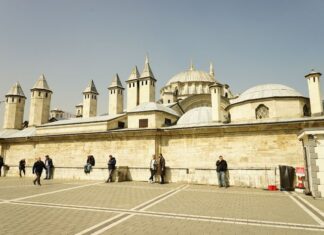
Skopia contains a great number of mosques, which may also be called Turkish churches. These buildings show how strong and settled the Turkish presence has become in the city. Among all of them, the finest mosque stands upon a hill overlooking the town. It is especially notable for its large portico, which is supported by four marble pillars. This portico gives the building both beauty and dignity and offers shade to those who gather there.
Near this mosque stands a wooden tower, inside which there is a clock and a bell. From this high place, I enjoyed a wide and pleasant view of the whole city and the surrounding countryside. The sight helped me better understand the size, position, and importance of Skopia within the region Ephesus Guide.
Ancient Remains Within the City
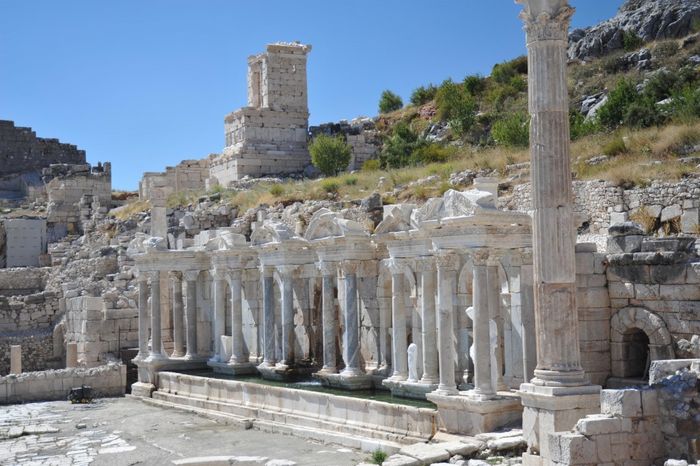
Within the city there are also several remains that appear to be ancient. One such feature is an old arch, beneath which a small stream or rivulet runs. This structure seems to belong to an earlier age and shows that the city existed long before its present rulers.
Not far from this arch lies a large stone, likely once part of a column. Upon it is an inscription reading “SHIANC”, though its meaning is now unclear. Such fragments suggest that Skopia was once richly built and decorated, especially during Roman times.
The Great Aqueduct
A short distance outside the city stands a noble stone aqueduct, one of the most impressive structures in the area. It stretches from one hill to another, crossing the valley between them. This aqueduct is made up of around two hundred arches, all carefully constructed and well aligned. It once carried water into the city and remains a striking example of ancient engineering skill Turning from the Main Road.
The aqueduct not only served a practical purpose but also added honor and beauty to the city. Even in its present state, it stands as a strong reminder of Skopia’s former greatness.
Roman History and Early Importance
Skopia was an important place during Roman times. Many great actions were performed here, especially by Regillianus, as recorded by Trebellius Pollio. According to this historian, Regillianus won many battles and carried out such notable deeds at Skopia that he fully deserved a triumph.
Nearby once stood other Roman settlements, including Scopolis and Ulpiana, further proving that this region held great importance in ancient times.
Ottoman Rule and Administration
When Mahomet the First conquered Skopia, he settled a colony of Asians in the city. This action greatly increased the Turkish character of the population and customs. As a result, the city became more firmly integrated into the Ottoman world.
Administratively, the Sanjak of Skopia is under the authority of the Beglerbeg of Rumelia, also known as Gracia. This places Skopia within one of the most important provinces of the Ottoman Empire.
Trade and Final Observations
Skopia maintains active trade routes with Belgrade, Thessalonica (Salonichi), and many other cities. Merchants travel frequently between these places, carrying goods that support the local economy and connect Skopia with wider markets.
I have written at greater length about this city because many geographers mention it only briefly, and I had never encountered any writer who had actually visited it. For this reason, I believed it necessary to describe Skopia more fully, so that its importance, beauty, and history might be better known.